Buy gfxspace.com ?
We are moving the project
gfxspace.com .
Are you interested in purchasing the domain
gfxspace.com ?
domain@kv-gmbh.de · 0541-91531010
Buy gfxspace.com ?
How do you calculate the braking distance, the braking process, and the braking deceleration?
The braking distance can be calculated using the formula: braking distance = (initial velocity^2) / (2 * deceleration), where the deceleration is the rate at which the vehicle slows down. The braking process involves the driver applying the brakes, which causes friction between the brake pads and the wheels, leading to a decrease in the vehicle's speed. The braking deceleration can be calculated by dividing the change in velocity by the time it takes for the vehicle to come to a complete stop. **
How do you calculate the braking time and braking distance?
Braking time and braking distance can be calculated using the formula: Braking distance = (initial velocity^2) / (2 * deceleration) Where initial velocity is the speed of the vehicle before braking, and deceleration is the rate at which the vehicle slows down. Braking time can be calculated by dividing the braking distance by the initial velocity. These calculations are based on the assumption of constant deceleration, and may vary depending on factors such as road conditions and the vehicle's braking system. **


Similar search terms for Braking
Top-Angebote
Products related to Braking:
-
Funko Pop! Animation Rilakkuma Kiiroitori Vinyl Figure #2363Add a cheerful touch to your collection with this Funko Pop! Animation Kiiroitori figure from the Rilakkuma series. This adorable yellow bird is captured in Funko's distinctive stylized vinyl format, with its rounded body, bright orange beak, expressive dark eyes, and tiny brown feet. Known as Rilakkuma's hardworking and tidy companion, Kiiroitori makes a charming standalone display piece and pairs well with other Rilakkuma characters and Funko Pop! Animation figures. The collectible comes in a colorful window display box, making it suitable for displaying unopened or taking out for closer inspection. Key features include an officially licensed Rilakkuma Kiiroitori collectible Funko Pop! Animation vinyl figure, measuring approximately 7.4 cm in height. It is presented in a collector-friendly window display box, ideal for Rilakkuma, anime, and Funko Pop! collectors. The product dimensions are approximately 15.9 x 11.5 x 8.8 cm (H x W x D), and it is recommended for ages 3 years and over. Contains small parts.13,59 £*Shipping: 3,95 £Secure redirect to the provider
-
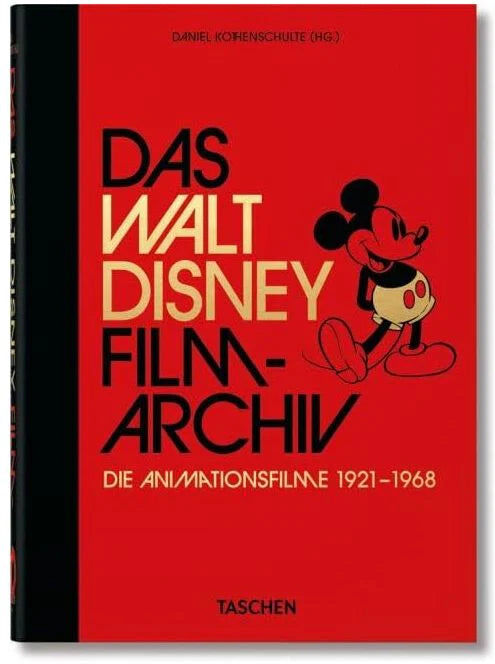
Das Walt Disney Filmarchiv (German Edition) by Daniel Kothenschulte - TASCHEN Hardback - Disney Animation History Art Book - 512pp Collector's EditionThis German-language edition of Das Walt Disney Filmarchiv is a compact 40th anniversary edition of TASCHEN's landmark survey of Walt Disney's animated features. Written and curated by film historian Daniel Kothenschulte, this lavishly illustrated hardback book traces the studio's complete animation journey from its silent-era beginnings through to the last features made under Walt Disney's personal creative direction. Packed with rare artwork, concept paintings, and behind-the-scenes photography, it is a substantial reference work for serious collectors, film historians, and lifelong Disney enthusiasts.24,00 £*Shipping: 2,99 £Secure redirect to the provider
-
Funko Pop! Animation: Peanuts - Franklin #2093 - Collectible Vinyl FigureBring a much-loved Peanuts character to your collection with this Funko Pop! Franklin vinyl figure. Franklin is presented in Funko's distinctive stylized design, holding his beach ball and ready to join your Peanuts display. This collectible figure is supplied in an illustrated window display box, allowing the character to be viewed while packaged. It is designed for collectors, Peanuts fans, and anyone who enjoys classic animated characters in Pop! form. The figure is made of vinyl and is recommended for ages 3 and over. Display Franklin alongside other Peanuts collectibles or keep him boxed as part of your Funko collection. The supplied version is a single Franklin figure.11,49 £*Shipping: 3,95 £Secure redirect to the provider
-
Funko Pop! Animation Bluey Granny Rita Vinyl Figure #2369 - CollectablesOfficial Funko Pop! Animation release featuring Bluey’s Granny Rita in her purple granny costume holding a handbag. Oversized head and expressive eyes capture the character’s distinctive look. Ideal for display in a Funko Pop! collection.11,49 £*Shipping: 3,95 £Secure redirect to the provider



-
What are the differences between braking to walking speed and braking?
Braking to walking speed typically involves gradually reducing speed until coming to a complete stop, whereas braking refers to the act of slowing down a moving vehicle. When braking to walking speed, the goal is to smoothly decelerate without any sudden stops, while braking may involve more forceful actions to slow down quickly. Additionally, braking to walking speed is often used in situations where a vehicle needs to stop at a precise location, such as at a crosswalk or intersection. **
-
How do you calculate braking time and braking distance in physics?
In physics, braking time and braking distance can be calculated using the equations of motion and the principles of kinematics. The braking time can be calculated using the equation t = v/u, where t is the braking time, v is the final velocity, and u is the initial velocity. The braking distance can be calculated using the equation d = (v^2 - u^2) / (2a), where d is the braking distance and a is the deceleration. These equations take into account the initial and final velocities, as well as the deceleration of the object to determine the braking time and distance. **
-
Is braking a reflex?
Braking can be considered a reflex in certain situations. When a driver reacts to a sudden obstacle or hazard on the road by immediately pressing the brake pedal, it can be seen as a reflexive action. This is because the response is automatic and occurs without conscious thought. However, braking can also be a learned behavior, as drivers are trained to use their brakes in specific situations through practice and experience. Therefore, while braking can be a reflex in some cases, it can also be a learned and intentional action. **
-
What is the formula for braking acceleration and braking time in physics?
The formula for braking acceleration is given by \( a = \frac{v_f - v_i}{t} \), where \( a \) is the braking acceleration, \( v_f \) is the final velocity, \( v_i \) is the initial velocity, and \( t \) is the time taken to come to a stop. The formula for braking time can be calculated using the equation \( t = \frac{v_f - v_i}{a} \), where \( t \) is the braking time. These formulas are used to calculate the rate at which an object slows down when braking. **


What is the difference between a full braking and an emergency braking?
Full braking refers to applying the brakes with maximum force in a controlled manner to slow down or stop the vehicle. This can be done in response to normal traffic conditions or when approaching a stop sign or traffic light. On the other hand, emergency braking is a sudden and forceful application of the brakes in response to an unexpected hazard or danger, such as a pedestrian stepping into the road or a vehicle suddenly stopping in front. Emergency braking is typically done to avoid a collision and requires quick reflexes and a strong, immediate response from the driver. **
What is the difference between braking with a clutch and braking without?
Braking with a clutch involves pressing the clutch pedal while simultaneously applying the brakes, which disengages the engine from the transmission and allows the vehicle to coast to a stop. This method is often used in manual transmission vehicles to prevent stalling. On the other hand, braking without using the clutch means simply applying the brakes without disengaging the engine from the transmission, which can cause the vehicle to stall if the engine speed drops too low. In summary, the main difference is that braking with a clutch allows the vehicle to coast to a stop without stalling, while braking without the clutch can potentially lead to stalling if not done properly. **
Top-Angebote
Products related to Braking:
-
Funko Pop! Animation Jin Kougasaki - Chance of Chase - 11.2 cm - Pop! Animation Box 2441Official Funko Pop! Animation figure of Jin Kougasaki from Tougen Anki. Features his Rasetsu Academy uniform with face mask and dark clothing. Includes Pop! Animation Box Number 2441. 11.2 cm tall. Chance of Chase release with 1 in 6 probability of a maskless variant.11,49 £*Shipping: 3,95 £Secure redirect to the provider
-
Funko Pop! Animation Bluey Queen Chilli Vinyl Figure #2373 - 10.4 cm Tall - Official Funko Pop! AnimationBring a regal touch to your Bluey collection with the Funko Pop! Animation Bluey Queen Chilli vinyl figure. Inspired by Chilli's royal appearance in the beloved Bluey episode 'Queens', this charming vinyl figure captures Bluey's mum dressed up as a queen and ready for imaginative play. Queen Chilli is styled in Funko's instantly recognizable Pop! design, with an oversized head, expressive eyes, and a beautifully detailed character sculpt. She wears her decorative crown and colourful cape, while her magnifying glass adds a playful detail that fans of the episode will recognize. Standing approximately 10.4 cm tall, she makes a great addition to a desk, shelf, or Bluey display. This figure is supplied in its individual window display box, featuring Bluey branding and allowing the figure to be viewed while keeping it protected. The figure is part of the Pop! Animation series, numbered #2373.11,21 £*Shipping: 3,95 £Secure redirect to the provider
-
Funko Pop! Animation Rilakkuma Kiiroitori Vinyl Figure #2363Add a cheerful touch to your collection with this Funko Pop! Animation Kiiroitori figure from the Rilakkuma series. This adorable yellow bird is captured in Funko's distinctive stylized vinyl format, with its rounded body, bright orange beak, expressive dark eyes, and tiny brown feet. Known as Rilakkuma's hardworking and tidy companion, Kiiroitori makes a charming standalone display piece and pairs well with other Rilakkuma characters and Funko Pop! Animation figures. The collectible comes in a colorful window display box, making it suitable for displaying unopened or taking out for closer inspection. Key features include an officially licensed Rilakkuma Kiiroitori collectible Funko Pop! Animation vinyl figure, measuring approximately 7.4 cm in height. It is presented in a collector-friendly window display box, ideal for Rilakkuma, anime, and Funko Pop! collectors. The product dimensions are approximately 15.9 x 11.5 x 8.8 cm (H x W x D), and it is recommended for ages 3 years and over. Contains small parts.13,59 £*Shipping: 3,95 £Secure redirect to the provider
-
Das Walt Disney Filmarchiv (German Edition) by Daniel Kothenschulte - TASCHEN Hardback - Disney Animation History Art Book - 512pp Collector's EditionThis German-language edition of Das Walt Disney Filmarchiv is a compact 40th anniversary edition of TASCHEN's landmark survey of Walt Disney's animated features. Written and curated by film historian Daniel Kothenschulte, this lavishly illustrated hardback book traces the studio's complete animation journey from its silent-era beginnings through to the last features made under Walt Disney's personal creative direction. Packed with rare artwork, concept paintings, and behind-the-scenes photography, it is a substantial reference work for serious collectors, film historians, and lifelong Disney enthusiasts.24,00 £*Shipping: 2,99 £Secure redirect to the provider
-
How do you calculate the braking distance, the braking process, and the braking deceleration?
The braking distance can be calculated using the formula: braking distance = (initial velocity^2) / (2 * deceleration), where the deceleration is the rate at which the vehicle slows down. The braking process involves the driver applying the brakes, which causes friction between the brake pads and the wheels, leading to a decrease in the vehicle's speed. The braking deceleration can be calculated by dividing the change in velocity by the time it takes for the vehicle to come to a complete stop. **
-
How do you calculate the braking time and braking distance?
Braking time and braking distance can be calculated using the formula: Braking distance = (initial velocity^2) / (2 * deceleration) Where initial velocity is the speed of the vehicle before braking, and deceleration is the rate at which the vehicle slows down. Braking time can be calculated by dividing the braking distance by the initial velocity. These calculations are based on the assumption of constant deceleration, and may vary depending on factors such as road conditions and the vehicle's braking system. **
-
What are the differences between braking to walking speed and braking?
Braking to walking speed typically involves gradually reducing speed until coming to a complete stop, whereas braking refers to the act of slowing down a moving vehicle. When braking to walking speed, the goal is to smoothly decelerate without any sudden stops, while braking may involve more forceful actions to slow down quickly. Additionally, braking to walking speed is often used in situations where a vehicle needs to stop at a precise location, such as at a crosswalk or intersection. **
-
How do you calculate braking time and braking distance in physics?
In physics, braking time and braking distance can be calculated using the equations of motion and the principles of kinematics. The braking time can be calculated using the equation t = v/u, where t is the braking time, v is the final velocity, and u is the initial velocity. The braking distance can be calculated using the equation d = (v^2 - u^2) / (2a), where d is the braking distance and a is the deceleration. These equations take into account the initial and final velocities, as well as the deceleration of the object to determine the braking time and distance. **
Similar search terms for Braking
-
Funko Pop! Animation: Peanuts - Franklin #2093 - Collectible Vinyl FigureBring a much-loved Peanuts character to your collection with this Funko Pop! Franklin vinyl figure. Franklin is presented in Funko's distinctive stylized design, holding his beach ball and ready to join your Peanuts display. This collectible figure is supplied in an illustrated window display box, allowing the character to be viewed while packaged. It is designed for collectors, Peanuts fans, and anyone who enjoys classic animated characters in Pop! form. The figure is made of vinyl and is recommended for ages 3 and over. Display Franklin alongside other Peanuts collectibles or keep him boxed as part of your Funko collection. The supplied version is a single Franklin figure.11,49 £*Shipping: 3,95 £Secure redirect to the provider
-
Funko Pop! Animation Bluey Granny Rita Vinyl Figure #2369 - CollectablesOfficial Funko Pop! Animation release featuring Bluey’s Granny Rita in her purple granny costume holding a handbag. Oversized head and expressive eyes capture the character’s distinctive look. Ideal for display in a Funko Pop! collection.11,49 £*Shipping: 3,95 £Secure redirect to the provider
-
Funko Pop! Animation Mudano - Officially Licensed Collectible - 12.4 cm TallOfficially licensed Tougen Anki Funko Pop! Vinyl Figure 2442 featuring Naito Mudano in his signature black suit and red umbrella with black-and-white striped shirt and rollerblades.12,29 £*Shipping: 3,95 £Secure redirect to the provider
-
Skip's Garage Deer Illustration Cornhole Boards"Includes: (2) ACA Regulation Size Cornhole Boards. Boards are Regulation 24"" Wide x 48"" Long. Easily Add All-Weather Resin Filled Bags. Add Accessories like a Carrying Case or Board Lights. Lights are Multicolor and Easily Change Colors & Modes."351,99 $*Shipping: 0,00 $Secure redirect to the provider
-
Is braking a reflex?
Braking can be considered a reflex in certain situations. When a driver reacts to a sudden obstacle or hazard on the road by immediately pressing the brake pedal, it can be seen as a reflexive action. This is because the response is automatic and occurs without conscious thought. However, braking can also be a learned behavior, as drivers are trained to use their brakes in specific situations through practice and experience. Therefore, while braking can be a reflex in some cases, it can also be a learned and intentional action. **
-
What is the formula for braking acceleration and braking time in physics?
The formula for braking acceleration is given by \( a = \frac{v_f - v_i}{t} \), where \( a \) is the braking acceleration, \( v_f \) is the final velocity, \( v_i \) is the initial velocity, and \( t \) is the time taken to come to a stop. The formula for braking time can be calculated using the equation \( t = \frac{v_f - v_i}{a} \), where \( t \) is the braking time. These formulas are used to calculate the rate at which an object slows down when braking. **
-
What is the difference between a full braking and an emergency braking?
Full braking refers to applying the brakes with maximum force in a controlled manner to slow down or stop the vehicle. This can be done in response to normal traffic conditions or when approaching a stop sign or traffic light. On the other hand, emergency braking is a sudden and forceful application of the brakes in response to an unexpected hazard or danger, such as a pedestrian stepping into the road or a vehicle suddenly stopping in front. Emergency braking is typically done to avoid a collision and requires quick reflexes and a strong, immediate response from the driver. **
-
What is the difference between braking with a clutch and braking without?
Braking with a clutch involves pressing the clutch pedal while simultaneously applying the brakes, which disengages the engine from the transmission and allows the vehicle to coast to a stop. This method is often used in manual transmission vehicles to prevent stalling. On the other hand, braking without using the clutch means simply applying the brakes without disengaging the engine from the transmission, which can cause the vehicle to stall if the engine speed drops too low. In summary, the main difference is that braking with a clutch allows the vehicle to coast to a stop without stalling, while braking without the clutch can potentially lead to stalling if not done properly. **
* All prices are inclusive of VAT and, if applicable, plus shipping costs. The offer information is based on the details provided by the respective shop and is updated through automated processes. Real-time updates do not occur, so deviations can occur in individual cases. ** Note: Parts of this content were created by AI.